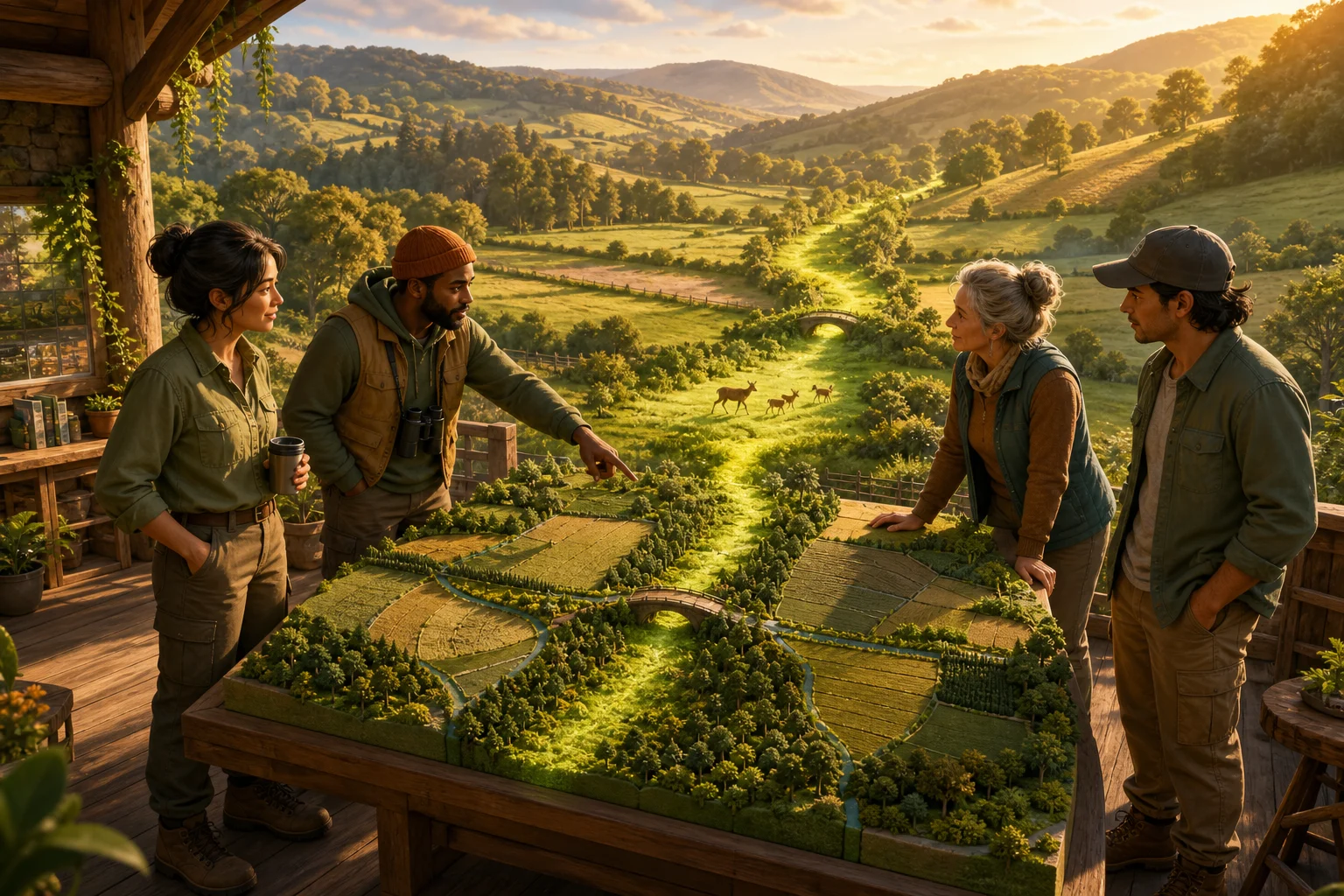
Your riverside parcel is the final link between farmland, a central woodland, and a western development site. A corridor forms if all four owners protect their land, but an early protector bears the cost if the others develop. Read the first outcome, identify the uncertainty, and design one commitment or guarantee. See how decisions change, then test your institution against rising land prices.
4 simultaneous parcels1 institution1 shock
GAME THEORY YOU WILL LEARN
Stag hunt / assurance game: learn why groups coordinate on either a high-value cooperative equilibrium or a safer low-value equilibrium.
Your path through the game
How to play and what to look for
First choose development, early protection, or a statement of conditional intent, then inspect all four outcomes. Choose one institution: an all-party commitment, a guarantee for early movers, or a payment for the crucial parcel. See how decisions change, then test the corridor, livelihoods, and trust against rising land prices.
01
Read the four owners’ concerns and choose how to use your land.
02
Choose one institution and see how the four owners respond.
03
Compare the corridor, livelihoods, and trust after land prices rise.
What makes it rewarding
The people stay the same, but changing the agreement changes whether the land connects. See a hesitation about being the only person to lose give way to a shared corridor. Playing again with another institution lets you compare how cooperation forms and which vulnerabilities remain afterward.
Game theory you will learn
Explore a stag hunt, also called an assurance game: cooperation creates greater value when everyone joins. Compare decisions before and after an institution is introduced to see how credible participation and protection against first-mover losses can change the group’s choices.
Questions to take away
Whose concern did your institution reduce, and how? Explain why protection continued when land prices rose, and identify the burden that remained. Use that insight to think about what could support the first step when people make a shared local commitment.
Four players choose by risk, not morality
Read not only who they are, but what they fear and the condition under which they will protect. Those rules are your evidence for choosing an institution.
Aoi
Eastern land steward
Goal
Protect farm income and pass on viable land
Fear
Conserving alone while others capture rising land value
Outside option
Develop a warehouse alone (safe payoff 3)
Best response
No assurance: develop for 3 / all four assured: protect for 8
Decision test
Can the opportunity cost of conserving alone be removed?
Malik
Central woodland owner
Goal
Keep forestry income and renew the woodland
Fear
Carrying the critical corridor link without compensation
Outside option
Prioritize a timber contract (safe payoff 3)
Best response
No assurance: develop for 3 / all four assured: protect for 8
Decision test
Is the critical parcel compensated for its burden?
Lena
Western community developer
Goal
Deliver housing and a flood-resilient town
Fear
Other parcels withdrawing after she commits
Outside option
Build a small housing project (safe payoff 3)
Best response
No assurance: develop for 3 / all four assured: protect for 8
Decision test
Are the other three commitments binding?
You
River-edge steward and corridor coordinator
Goal
Connect four parcels while protecting every livelihood
Fear
Relying on goodwill and concentrating the loss on one steward
Outside option
Manage isolated conservation pockets
Best response
Develop 3 / all protect 8 / protect alone −2
Decision test
A signal alone leaves all three developing; an institution moves all three to protection.
WILD LINK | Wildlife Corridor Assurance Game|NATURE PLAYWORKS